
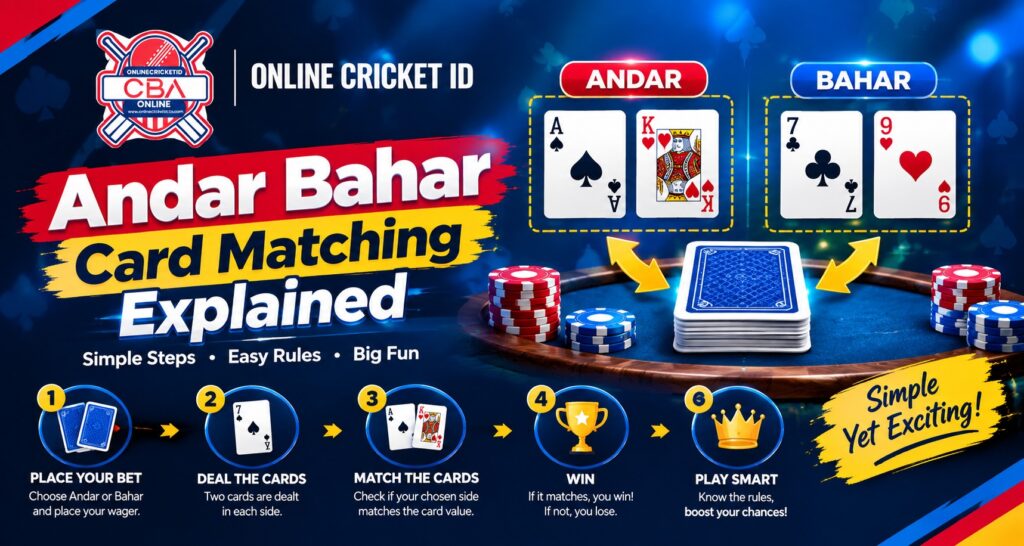
Andar Bahar is a simple card game built around one central card and two sides: Andar and Bahar. The main objective is to identify which side receives a card matching the rank of the opening card first. For beginners, understanding the matching process is more important than memorizing complicated terminology. On Online Cricket ID, users learning about card-game mechanics can benefit from understanding how the opening card, matching rank, and alternating deal work together.
The game is generally played with a standard 52-card deck. One card is revealed first, and its rank becomes the target for the remainder of the round. The dealing continues until another card of that same rank appears.
What Is Card Matching in Andar Bahar?
Card matching is the central mechanic of Andar Bahar.
The process begins when a dealer reveals one card. That card establishes the rank that must be matched.
For example:
- Opening card: 8 of Hearts
- Target rank: 8
- Matching card: Any remaining 8
- Winning side: The side receiving the matching 8
The suit does not normally need to match. If the opening card is an 8 of Hearts, an 8 of Spades, Clubs, or Diamonds can complete the round.
Understanding the Opening Card
The first revealed card is often referred to as the game card or middle card. Some versions may use the term “joker” for this card, but it does not mean that an actual joker card has been placed into the deck.
Its primary purpose is to establish the target rank.
For example, if the opening card is:
- King of Clubs → target is King
- 4 of Diamonds → target is 4
- Ace of Spades → target is Ace
Once the target is established, the remaining dealing sequence begins.
How Andar and Bahar Work
The two sides represent the possible locations where the matching card can appear first.
They are commonly arranged as:
- Andar: one side of the table
- Bahar: the opposite side
Cards are dealt toward these sides according to the particular game’s dealing procedure.
The key question throughout the round is simple: which side receives the matching rank first?
Step-by-Step Card Matching Process
A typical round can be understood through the following sequence:
1. Deck Preparation
The cards are prepared and shuffled according to the game’s procedure.
2. Opening Card
One card is revealed and placed as the central card.
3. Target Rank Is Established
The rank of the opening card becomes the matching target.
4. Andar and Bahar Are Set
The two dealing positions are established before the main sequence begins.
5. Cards Are Dealt
Cards are placed toward the two sides according to the table’s rules.
6. Matching Card Appears
The first card matching the opening rank determines the result.
7. Round Ends
Once the matching card appears, no additional cards are required for that round.
Does the Suit Matter?
For standard Andar Bahar matching, the suit is generally not the deciding factor.
Suppose the opening card is the 6 of Diamonds. The target is simply the rank 6.
Therefore, any remaining 6 can complete the matching condition.
This is different from games where both rank and suit can influence a winning combination.
What Happens When the Matching Card Appears?
The side receiving the matching card determines the round’s result.
For example:
- Andar receives the matching rank → Andar is the matching side.
- Bahar receives the matching rank → Bahar is the matching side.
The round then finishes according to the applicable table rules.
Users completing an Online Cricket ID Login should check the specific game’s displayed rules because digital versions can differ in presentation, side-selection procedures, or additional features.
Why the Matching Card Can Appear at Different Times
The exact point at which the matching rank appears cannot normally be known beforehand.
After the opening card is removed, several cards of the same rank remain in the deck. Their positions are determined by the shuffled deck.
The matching card could therefore appear:
- Very early
- After several deals
- Much later in the sequence
This is why the length of each round can vary.
Common Beginner Mistakes
New players sometimes misunderstand the matching process.
Common mistakes include:
- Thinking the suit must match
- Believing the opening card itself determines the winner
- Assuming the matching card must appear immediately
- Confusing the game card with a joker card
- Assuming previous rounds determine the next matching card
Understanding the basic sequence can prevent these misunderstandings.
Does the Previous Round Affect Card Matching?
A previous result does not automatically determine the next round.
Each new round involves a new game setup, and users should not assume that a particular side is “due” to win because it lost several previous rounds.
Past results can describe what already happened, but they do not guarantee what will happen next.
Card Matching on Mobile Platforms
Digital versions can display the game in a simplified interface.
The screen may show:
- Central opening card
- Andar area
- Bahar area
- Cards as they are dealt
- Round result
The Online Cricket Betting ID environment may use different layouts depending on the available game provider, so users should read the rules shown on the specific table.
Understanding Game Rules Before Playing
Different versions of Andar Bahar can include variations in:
- Starting-side procedures
- Payout structures
- Optional side markets
- Betting periods
- Table limits
The core matching principle may remain similar, but users should not assume that every version follows identical rules.
Responsible Gaming Awareness
Understanding card matching explains how the game works, but it does not create a guaranteed method of predicting results.
Users should:
- Learn the rules first
- Set personal limits
- Avoid chasing losses
- Take breaks
- Treat games as entertainment
For users comparing a Best Online Cricket ID Provider, clear rules and transparent information should be considered important factors.
Conclusion
Andar Bahar card matching is based on one straightforward principle: an opening card establishes a target rank, and cards are subsequently dealt toward Andar and Bahar until that rank appears again. The side receiving the matching card determines the result according to the applicable rules.
The most important beginner concepts are that the rank matters, the suit generally does not, and the exact timing of the matching card cannot be guaranteed. Understanding these basics makes the structure of an Andar Bahar round much easier to follow.
FAQs
What is card matching in Andar Bahar?
Card matching means finding another card with the same rank as the opening card.
Does the suit need to match?
No. In the standard format, the matching card needs to share the same rank rather than the same suit.
What is the opening card?
The opening card is the first card revealed and establishes the target rank for the round.
When does an Andar Bahar round end?
The round ends when a card matching the opening card’s rank appears on one of the two sides.
Can the matching card appear at any time?
Yes. Its position in the shuffled deck determines when it appears.
Does the previous round affect the next round?
No. Previous results do not guarantee the outcome or matching side of a new round.
Should beginners check the rules of each table?
Yes. Different versions may have variations in dealing procedures, payouts, and additional features.