
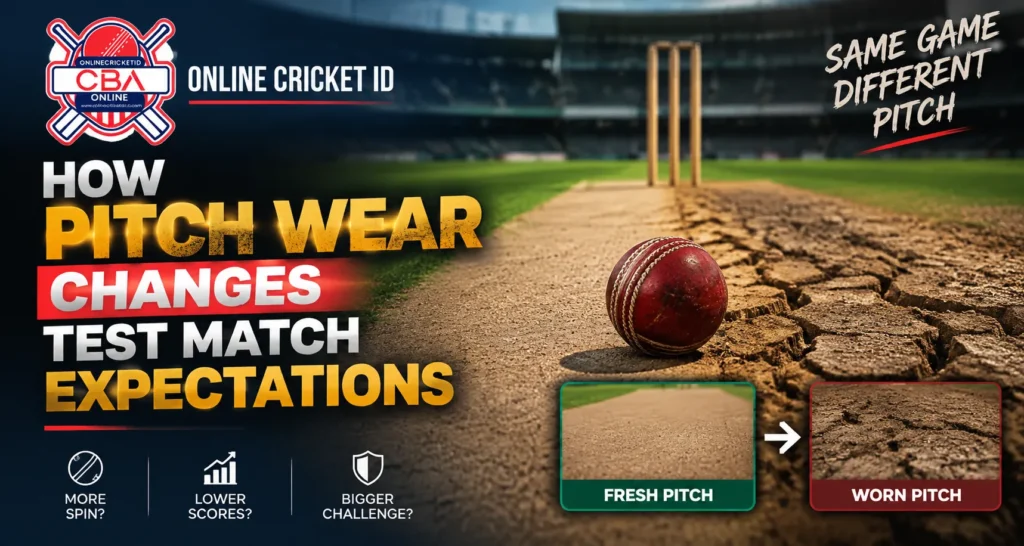
Test cricket is known for its changing conditions, and one of the biggest factors influencing a match over five days is pitch wear. Unlike shorter formats, a Test pitch naturally changes as players continue to bat, bowl, and field on the same surface. On Online Cricket ID platforms, cricket followers analyzing matches often consider pitch behavior because it can influence team strategies, player performances, and expectations throughout the game.
A pitch that looks ideal on the first day may provide completely different challenges on the fourth or fifth day. Understanding how wear develops helps explain why Test matches can shift dramatically between sessions.
What Is Pitch Wear in Test Cricket?
Pitch wear refers to the gradual deterioration of the playing surface as a Test match progresses.
Every delivery creates some level of impact on the pitch. Fast bowlers land repeatedly on the same areas, batters run between the wickets, and fielders create additional pressure on the surface.
Over time, pitch wear can create:
- Cracks and uneven areas
- Reduced grass coverage
- Changes in bounce
- More assistance for spin bowling
- Reverse swing opportunities
- Difficult batting conditions
These changes are a natural part of long-format cricket.
Why Does a Test Pitch Change Over Five Days?
A Test match can last up to five days, giving the surface much more time to develop characteristics compared with limited-overs cricket.
During the early stages:
- The pitch is usually harder
- Bounce is often more predictable
- Fast bowlers may get movement
- Batters can play more freely
As the match progresses:
- Footmarks become larger
- Cracks may open
- Bounce may become inconsistent
- Spin can become more effective
- Shot-making becomes more difficult
A user checking information through an Online Cricket ID Login can notice that match conditions are often described differently from one day to another because the pitch itself is evolving.
How Pitch Wear Affects Batting
Pitch deterioration can significantly change batting difficulty.
Early in the match, batters usually benefit from a fresher surface. The ball often comes onto the bat better, allowing players to play attacking shots with more confidence.
Later, batting can become challenging because:
- The ball may turn unexpectedly
- Bounce may vary
- Foot movement becomes more important
- Defensive techniques are tested
- Mistakes become more costly
Experienced Test batters often focus on patience because conditions may become harder as the game continues.
Impact on Fast Bowlers
Pitch wear does not only help spin bowlers. Fast bowlers can also benefit from a changing surface.
As cracks develop, fast bowlers may find:
- Extra movement off the pitch
- Uneven bounce
- Reverse swing assistance
- Greater difficulty for batters
Older balls can become effective when combined with rough areas and dry conditions.
This is why fast bowlers often remain dangerous even during the later stages of a Test match.
Why Spinners Become More Important Later
One of the biggest effects of pitch wear is increased assistance for spin bowling.
As the surface becomes rougher, spinners may get:
- More turn
- Additional bounce variation
- Greater control over batters
- More opportunities from footmarks
Teams often plan their bowling attacks based on how they expect the pitch to behave on days four and five.
A strong spin attack can become a major advantage when the surface begins breaking down.
Footmarks and Their Role in Pitch Wear
Footmarks are areas created when bowlers repeatedly land in the same place during their delivery stride.
These marks can become important later in the match, especially for spinners.
Left-arm and right-arm bowlers may create different angles of rough areas, allowing bowlers to target specific zones.
Footmarks can cause:
- Sudden turn
- Lower bounce
- Unpredictable deliveries
- Increased pressure on batters
This is one reason why captains carefully manage bowling changes throughout a Test.
How Teams Adjust Their Strategies
Successful Test teams adapt as conditions change.
Batting adjustments may include:
- Playing with greater patience
- Leaving more deliveries
- Reducing risky shots
- Using defensive techniques
Bowling adjustments may include:
- Attacking specific areas
- Using spin for longer spells
- Changing field placements
- Targeting rough patches
A team that reads pitch changes correctly can gain a significant advantage.
Pitch Wear and Match Predictions
Pitch wear makes Test cricket difficult to predict because conditions can change rapidly.
A team that dominates the first two days may struggle later if the surface begins helping bowlers.
When analyzing a match through an Online Cricket Betting ID, users should consider factors such as:
- Current pitch condition
- Weather impact
- Type of bowling attack
- Batting depth
- Previous performances at the venue
- Match situation
The condition of the pitch is often just as important as the quality of the players.
Different Types of Pitch Wear
Not all pitches wear in the same way.
Common patterns include:
Dry Pitch Wear
Dry surfaces often crack faster and can provide significant assistance to spinners.
Green Pitch Wear
Surfaces with more grass may support seam bowling early before becoming more balanced.
Hard Pitch Wear
Hard surfaces may remain good for batting longer but eventually develop uneven bounce.
Understanding the type of surface helps explain why different Test venues produce different match patterns.
Why Pitch Reading Matters for Cricket Analysis
Pitch behavior is one of the most important parts of Test cricket analysis. Players, coaches, and analysts study surfaces before and during matches to understand how conditions may develop.
For users searching for the Best Online Cricket Betting ID Provider, understanding cricket factors like pitch wear can help create a better understanding of match situations rather than focusing only on team names or past results.
Conclusion
Pitch wear is one of the reasons Test cricket remains unpredictable and challenging. A surface that starts as a batter-friendly pitch can gradually become difficult as cracks, rough areas, and uneven bounce develop.
Understanding how pitches change helps cricket followers appreciate team strategies, bowling choices, and match momentum. Whether analyzing a Test match before the first ball or following the final sessions, pitch condition remains a key factor in understanding how the game evolves.
FAQs
What is pitch wear in Test cricket?
Pitch wear refers to the gradual changes that occur on the playing surface due to repeated bowling, batting, and fielding activity.
Why do Test pitches become harder to bat on later?
As pitches wear, cracks, uneven bounce, and increased spin assistance can make batting more difficult.
Does pitch wear only help spin bowlers?
No. Fast bowlers can also benefit from rough surfaces, uneven bounce, and reverse swing conditions.
Why are footmarks important on a Test pitch?
Footmarks create rough areas that can help spinners generate more turn and variation.
Can pitch wear change the result of a Test match?
Yes. Changing pitch conditions can influence batting difficulty, bowling effectiveness, and team strategies.
How do teams prepare for pitch changes?
Teams study the surface, adjust tactics, manage bowlers, and change batting approaches according to evolving conditions.